
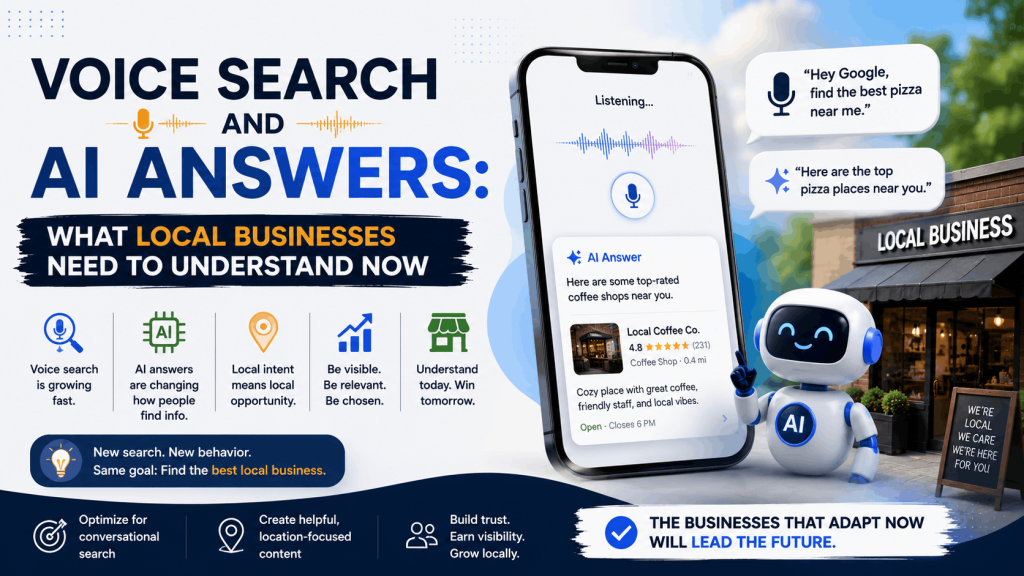
Someone driving with a dead phone charger asks their car’s assistant, ‘find a phone repair shop open now near me.’ That single spoken question triggers a very different process than typing the same words into a search bar. Voice search and AI-generated answers favor concise, structured, and highly local information, and most small businesses haven’t adjusted for that shift.
Understanding how these tools work isn’t optional anymore. It’s becoming part of basic digital literacy for any business that depends on local customers.
Why Voice Search Behaves Differently
Typed searches often return a page of results for a person to scan and compare. Voice search and AI assistants typically deliver one answer, sometimes two or three, out loud or in a short summary. That compression means only the businesses with the clearest, most consistent, and most locally specific information tend to get chosen.
Natural, conversational phrasing on your website and profile helps here, since voice queries mirror how people actually talk rather than how they type.
What AI Answer Engines Actually Rely On
AI Overviews, ChatGPT Search, and similar tools generate responses by synthesizing information from multiple sources rather than pulling from one page. They tend to favor businesses whose name, location, hours, and services are described the same way across several trustworthy sites, since conflicting details make it harder for these systems to generate a confident answer.
This is where structured business data, the kind found on well-maintained directories, becomes genuinely useful rather than just a formality.
Practical Ways to Prepare
Write your business description the way a customer would actually ask about you out loud, rather than in dense marketing language. Keep your hours and service areas current, since AI tools often reference this exact data when someone asks about availability.
Extending accurate information to platforms like StumblIO gives AI systems another consistent, well-organized source to reference, reinforcing what your website and Google Business Profile already say rather than contradicting it.
Conclusion
Voice search and AI answers reward clarity and consistency over cleverness. Small businesses that keep their information accurate, specific, and aligned across every place it appears put themselves in a better position to be the answer someone actually hears or reads, rather than a listing buried on page two.