
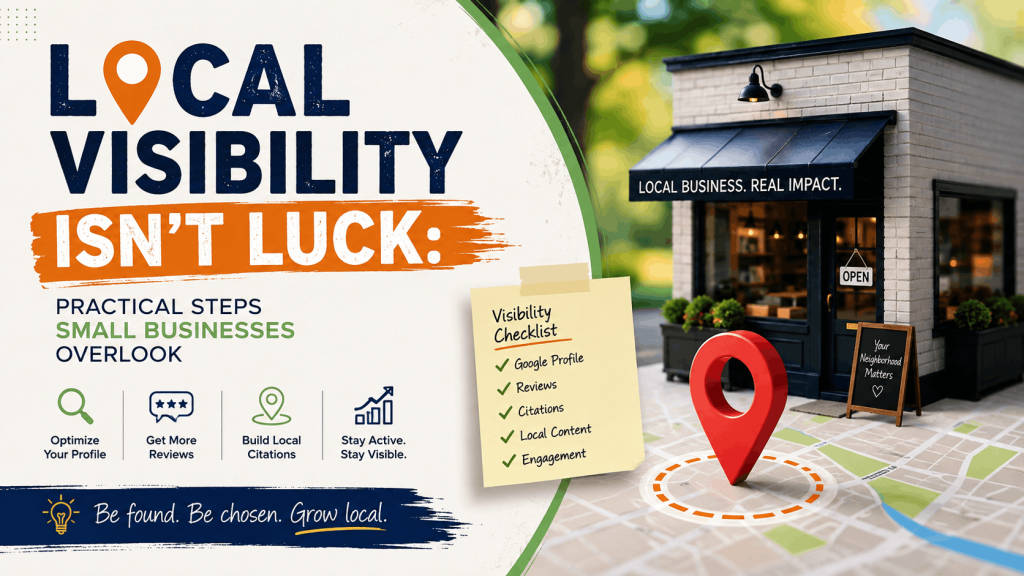
Ask ten small business owners how customers find them and most will say word of mouth or a sign out front. Ask how many people search online before ever driving past that sign, and the number climbs fast. Local visibility has quietly become the new storefront window, and most owners never bothered to clean the glass. This isn’t about chasing algorithms. It’s about making sure the basic, boring details of your business are easy for people and search tools to find, confirm, and trust.
Visibility Starts with Being Findable, Not Just Rankable
Before a business can rank well anywhere, it has to be discoverable in the first place. That means showing up when someone searches your business category plus your city, whether they type it into Google, ask a voice assistant, or query an AI chat tool. Findability depends on how many trustworthy sources mention your business consistently. A single website, no matter how polished, rarely accomplishes this alone. Search engines want corroboration from multiple, independent places.
The Overlooked Value of Category Accuracy
One mistake I see constantly: business owners list themselves under a category that’s close enough rather than exact. A mobile dog groomer listed simply as a pet store misses searches from people specifically looking for mobile grooming. Precision in how you categorize your business, on your Google Business Profile and on directories, directly affects whether the right customers ever see you. This same precision matters for AI-driven search, which tends to match specific intent to specific business descriptions rather than broad categories.
Where Directories Fit Into the Bigger Picture
Local visibility improves when your business appears accurately and repeatedly across the web. StumblIO serves this purpose by giving businesses a structured place to list precise categories, service areas, and contact information that search engines and AI tools can reference alongside your website and Google Business Profile. Think of it less as advertising and more as adding another verified data point that confirms you are exactly who you say you are, in the place you say you’re located.
Conclusion
Local visibility rarely comes down to one big move. It’s built from small, correct, repeated details spread across the places customers and search tools actually look. Businesses that treat those details with care tend to be found more easily by the people already searching for them.